

Above the Fold: November 18, 2025
BY ROB BEELER
Please note that this information is confidential and intended for the internal use of our partners only. The Above the Fold Report is an amalgamation of the discussions taking place within the Beeler.Tech universe. Much of what is presented is based on conversations held behind closed doors within the last week. The topics will range from the existential threats to publishers down to questions about how to use a specific feature in an ad server. We believe that if you are a publisher or someone who works with publishers, all of these provide opportunities to help or learn. The format of the report changes as the conversations change.

Quotes of the week
- “Ad ops in a nutshell… I wrote a JavaScript tag and contract on the same day. What job function is that…? Chief prompter lol.” – Lila Hunt
- “I used to think adtech had clear roles: buyers, sellers, and everything in between. Now? Everyone’s chasing everyone. And it’s starting to feel like we’ve automated the chaos.” – Jana Meron, LinkedIn Post

Community Feed
- Does anyone have any insight into this Nativo takeover? Seems like a slightly strange move… Life360 to Acquire Nativo, Accelerating Growth and Expanding Its Advertising Platform
- The EU is loosening up? EU Set the Global Standard on Privacy and AI. Now It’s Pulling Back | TechPolicy.Press
- Alt Identity Provider ID5 Buys TrueData, Marking Its First-Ever Acquisition | AdExchanger
- Historically, this market has always operated on the assumption of a near-infinite supply. If anything, the real challenge has always been creating meaningful demand density from advertisers and brands.” LinkedIn Post
- Doug Wintz is still at it: 50 Tasks that Rev Ops Pros Swear By When Configuring OMS Platforms!
- Stingray Acquires TuneIn, Creating an Audio Streaming and Advertising Powerhouse
- Congratulations to the team at The Telegraph for winning the Best Ad Ops Team award last night at The Wires.
- In the latest episode of the #ThePubWay podcast, Heather Carver (Chief Revenue Officer at Freestar) joins Tina & Mike to explore how AI, curation, and authenticity are reshaping publisher monetization and trust in the open web, covering: Link
- Web Without Walls Podcast Shay Brog, CEO of Burt Intelligence, and Vijay from Mile debate whether programmatic can ever escape cheap-reach economics, why curation remains a black box, and how retail and commerce media networks are rewriting the rules of digital advertising.
- I made a thing! Check out how I can seamlessly move loaded ads around in web content: I’ve created a tool. It turns ads into long-form content from lowest to highest performers, maximizes viewability, and improves advertiser outcomes. New cutting-edge ad logic innovation ready to implement today! – James Strang
- Good businesses know what their customers care about. Unilever, Ingka Group call for stronger government ambition at COP30
- EX.CO‘s latest industry guide is here! Built for publishing executives, audience strategists, and revenue leaders, this guide unpacks how AI-driven search, content summarization, and recommendation engines are reshaping the media ecosystem—and how smart publishers are responding. You can access it here https://hubs.li/Q03SXPPz0
- Index Exchange Sues Google Over Ad Auctions Practices, Joining Ballooning Coalition of Publishers, SSPs
- Amazon sues Perplexity over ‘agentic’ shopping tool. “saying this for a while now; consumer products like Amazon, Uber, Instacart, Spotify, Google Maps, etc., are not going to let agents come between them and the end user.”
- Agentic RTB Framework (ARTF) – open for public comment until Jan 15th.

Events
- MEFA Diversity & Inclusion Award Ceremony 2025 – Nov 19th
- Seedtag: Hi Friends! We are hosting a NY Publisher Holiday Party on Weds, Dec 3rd. Request an invite below and hope to see you all there: Link
- Christian Muche officially announced that Possible will expand to the Eden Roc next year – Link

This Week’s Top Community Topics (minus Agentic Advertising)
Q4 CPM Trends: A discussion on early-November CPMs centered on unexpectedly soft pricing, with multiple publishers stating that levels remained below typical seasonal norms and that the traditional “November pop” has weakened. Several participants pointed to softer open-market demand, while others noted that more budget is tied up in deal IDs and shifting retailer promotions that now extend through the quarter, potentially diluting the November uplift. Broader uncertainty—such as cautious marketing budgets—was also mentioned as a contributing factor. Toward the end of the thread, a few publishers reported CPM improvements after November 7th, underscoring uneven conditions across channels.
Additional discussion focused on noticeable shifts in The Trade Desk spend beginning in late October, with several publishers reporting declining DSP revenue and a corresponding rise in OpenPath activity. Some described OpenPath’s share growing meaningfully since the start of the year, prompting questions about whether recent earnings pressures or margin strategies might be influencing supply-path decisions. Participants noted that the shift appears non-incremental and not tied to premium CPMs, with the most visible early impacts evident in open auction performance. A few suggested that PMPs may also be affected, though less obviously. Despite the trend toward OpenPath/OpenAds, some publishers are maintaining SSP relationships as a hedge against potential changes. Additional commentary on TTD below.
Burt’s October open auction benchmarks report: Display CPM increased MoM and YoY compared to September, while video CPM went down. Notably, one advertiser achieved a significant >100% increase in video spending MoM. Full Report

PDP API: Discussion focused on The Trade Desk and PubMatic’s new API-based integration using TTD’s Price Discovery and Provisioning (PDP) API, which TTD expects will become the standard for all sell-side partners conducting deal-ID transactions. Participants viewed the development positively if it improves deal troubleshooting, noting frequent situations where sales teams ask about under-delivering deals despite limited visibility into buyer bidding behavior. Some felt a more transparent, API-driven workflow could reduce time wasted on deals that never transact and push buyers to engage more directly. Others suggested that if PDP gives deals more structure and “teeth,” negotiation volume may decline—potentially frustrating sales teams but ultimately benefiting operations by filtering out low-intent or low-activity deals.

Programmatic Trends: Discussion centered on SSP revenue-share flexibility programs from Magnite, Index Exchange, and PubMatic, with participants revisiting whether these yield-focused structures are delivering meaningful value. Several publishers reported that Index gained share in recent weeks, potentially tied to its flexible revenue-sharing approach, while PubMatic appears to be losing voice—often to OpenPath and Index. Some attributed OpenPath’s rapid growth to spend migration away from SSPs rather than incremental demand, even without TID adoption. Others raised concerns about flexible revenue shares, noting that higher SSP take rates in non-competitive auctions could subsidize bids in competitive ones, thereby reducing the true incremental value despite increased win rates.

Other Programmatic Partners: A conversation around Kueez revealed varied results across publishers. Some saw encouraging early performance, especially in-app, and consistently strong support from the team. Others reported that the incremental impact in their environments was more modest, and several chose not to continue testing after initial trials with their Prebid integrations. Participants generally agreed that Kueez’s partnership approach and communication were positive, even where performance outcomes differed.
A separate thread examined Sovrn’s announcement that it will transition to paying only on viewable impressions. Participants questioned the framing of this move as an “industry standard,” noting that most mainstream SSPs do not operate on vCPM for sellers. Several expressed concern it could reduce revenue unless CPMs rise accordingly. Confusion persisted around whether the policy applies to app thresholds (e.g., one pixel in view) or broader inventory. Comparisons to DV360’s bill-on-view changes sparked questions about discrepancies and potential misalignment across platforms.
A discussion centered on OnlineMediaSolutions (formerly Brightcom) as a potential partner. Several publishers reported strong recent results: top non-Google web revenue, high CPMs, responsive account management, and reliable (often early) payments. They rank in the top three in some header bidding stacks, sometimes outperforming major SSPs. Most run them via Prebid and describe experiences as broadly positive. Others pointed out that they are mostly a reseller.
A publisher’s question focused on whether Seedtag’s direct sales efforts create channel conflict with publishers’ own teams. Seedtag responded that conflicts are uncommon because their model targets broader 1-to-many demand rather than publisher-specific sales. They can block sensitive advertisers on request and emphasized that their goal is to elevate publisher inventory rather than compete directly.

Open Bidding Direct Pay: publishers reporting mixed outcomes. One participant implemented it at Media.net’s request and noted a brief dip in spend immediately after switching; however, performance later stabilized, and Direct Pay CPMs were meaningfully higher, even after accounting for the ad-serving fee. Another publisher tested the setup but chose not to continue, citing unanticipated backend work associated with managing the CPM-based payment structure. Overall, participants highlighted that operational requirements and outcomes may vary depending on each publisher’s setup.

Track your GAM policy violations. A publisher reported experiencing an unexpected and unusually large “Invalid Traffic – Ad Exchange for Content” deduction—nearly 30% of their monthly revenue, compared to the typical minimal adjustments. Google Support confirmed that the deduction originated from October AdX for Content activity, but could not provide specific details due to disclosure policies. Instead, they cited possible invalid clicks, impressions, or policy non-compliance and routed the case to the account manager, with a 3–5 day response window. Others noted past instances tied to ad-block recovery tools or AdX setup bugs, though repayment was not guaranteed. A later update flagged that one MCM child publisher had an entire site temporarily disabled for “Dangerous or derogatory content” violations, reinforcing the need for close monitoring of the Policy Center to avoid unexpected blocks or revenue disruptions.

US Opt Out CPM Hits: One publisher asked what level of revenue decline is typical for users who disable tracking in the US. Responses indicated steep reductions: some observed a roughly 75% drop in programmatic CPMs, while another noted that non-consented impressions—measured at the impression level rather than the user level—were closer to a 90% decline, although this experience was primarily in the UK.

Video creative reporting woes: Publishers encountering mismatched creative IDs in GAM—where the %ecid! macro outputs a different value than what appears in reporting—may struggle to reconcile attribution data with delivery data at the creative level. This inconsistency occurs because %ecid! returns the Creative Set ID, not the individual Creative ID. The recommended solution is to use the Master and Companion Creative ID dimensions in GAM reporting to create a reliable join. For setups using VAST without companions, ensure joins exclude companion rows to avoid duplication. Publishers should validate how their external attribution systems handle creative-set-level identifiers before finalizing data workflows.

Content Security Policy (CSP) Conversation explored whether Content Security Policy (CSP) can be deployed effectively on ad-supported sites. Publishers reported that strict CSP enforcement often conflicts with the volume of third-party JavaScript required for programmatic demand. One team spent months testing before disabling it due to an 85% revenue drop and heavy operational overhead. Others run CSP in block or report-only modes, noting that it remains technically feasible but requires trade-offs, dedicated monitoring, and alignment between engineering, product, and monetization teams.

Ad Quality: A publisher is receiving recurring complaints about low-quality or MFA-like ads and experiencing difficulty in classifying them for blocking. Participants recommended reviewing the creatives directly in GAM’s Ad Review Center and considering third-party ad-quality tools for broader enforcement. One publisher traced most problematic ads to a single network and blocked it, noting that GAM’s categories were too generic for precise filtering. Others suggested category-based workarounds—such as blocking swimwear or underwear—to reduce similar ads when direct categorization is unclear.

Which identifiers work? A discussion centered on publisher interest in identifying which identity solutions meaningfully improve header bidding performance and whether Prebid’s Enrichment Lift Measurement (ELM) module can help. Participants noted that many were unaware of the adapter, which is designed to measure how individual identifiers affect bid density and performance. Some publishers said it remains difficult to determine which IDs “work,” citing challenges with traffic slicing, split testing, and isolating effects across browsers, consent states, and SSP behaviors. Others viewed ELM as a potentially useful framework for structured testing, enabling publishers to evaluate lift from specific ID vendors more systematically. Several emphasized that simply adding more identifiers delivers diminishing returns—similar to SSP expansion—and that publishers need data to reduce their ID stack responsibly. One participant shared that controlled split tests showed measurable value from UID2 and LiveRamp ATS, while other identifiers added little incremental benefit. The group asked for additional experiences with ELM and strategies for managing ID sprawl.

Who is happy with their Ad Quality Vendor?
Asked this week, several publishers responded (responses summarized)
Boltive: Publishers reported positive experiences with Boltive, citing strong tech and supportive service. It performs well for creative scanning and ad-quality monitoring but does not address IVT. Overall, teams found it reliable and easy to work with for quality-focused workflows.
Confiant: Confiant was praised as a dependable long-term ad-quality partner. Publishers cited stable performance, strong support, and consistent success in identifying and blocking bad creatives. It’s considered a solid option for teams needing robust ad-quality controls and complementary IVT protections.
GeoEdge: GeoEdge earned positive feedback for its ad-quality tools, especially for Spechub, which streamlines direct-sold creative review. Publishers noted it saves significant operational time by validating creative specs before acceptance and provides dependable monitoring across programmatic inventory.
The Media Trust (TMT): TMT received repeated endorsements for effectiveness, though it may require some technical or Linux familiarity. Publishers highlighted its reliability and credited it with preventing weekend emergencies, noting it provides strong, proactive protection against problematic creatives and ad-quality issues.

Taking Action
- We started working earnestly as a community to develop some programmatic best practices. We are reaching out to demand partners to determine if they provide revenue through ads.txt lines, and if so, the format and frequency.
- Prebid 10.16 release this week contains a fix for EIDs affecting multiple larger Prebid adapters. If you’re currently testing Prebid 10, James Strang recommends that you test this version immediately. You may see an instant increase in Prebid win rates and RPM. Prebid.js 9.53.3 is out. This contains the bug fix for Prebid 9.
- Amazon’s lawsuit against Perplexity centers on two issues: Comet’s lack of a unique user-agent string and its agentic shopping tool, which can execute actions outside Amazon’s control. Participants noted that Comet also bypasses consent modals, suppresses ads, and blocks analytics—undermining both compliance and monetization. From a publisher’s perspective, Amazon’s stance highlights growing risks around agent-driven scraping, data loss, and unmonetized traffic. This may be the moment for publishers to align and push for stronger industry standards that protect consent, measurement, and commercial integrity.
- For those who have not signed up for the Publisher Quality Utility from the Brand Safety Institute, they have just added Mantis Solutions brand safety scores to the report. The tool is free and updated monthly, allowing you to check if your scores change and need to be addressed.

Human-Hallucinations-Only Summary of This Week’s Topics
In other words, this is manually compiled because we believe you deserve more than “good enough.”
- Amazon continues to be a point of discussion as people see drops in spend through Amazon pipes.
- CloudX.io mentioned. “I’m excited about it. We are going to integrate early next year.”
- Google Ad Manager Access Premium reporting – the jury is still out, but so far, the response has been negative, citing the expense and the limited functionality.
- Google’s Interactive Reports: Pubs generally agreed that while GAM’s native tools are improving, vendor-supported platforms remain valuable for joining data across multiple systems. Several noted that the core strength of Burt and Switchboard lies in ETL and cross-platform aggregation—something GAM alone cannot provide. Publishers handling data from sources like FreeWheel, LiveIntent, or social platforms still rely on external tools for unified reporting.
- “We came across some weird Discover behaviour these days – a mix-up of 2 brands within 1 Discover result.”
- Pangle: “We’ve avoided them in the past because we’re US only. They told me last month that they have found a way to go live in the US and are trialing with a few publishers. I am anxiously awaiting the results. TikTok shopping is a huge spender with us. If any of that revenue can come through a more efficient pipe, then I’d welcome that, but I need to see some proof that it drives outcomes first.”

Troubleshooting
A publisher reported a recent rise in Google Ad ID targeting restrictions observed in GAM’s Identity Insights for North American app traffic. They observed a notable increase in missing or personalization-disabled IDs starting around September 25 and again on October 22, despite no changes to their app, OS, or geo-level settings. The trend appeared consistent across app versions and Android builds. Other publishers shared their numbers, seeing stable levels, while others noted a smaller October 22 bump, but not as severe.

I’m encountering a reconciliation issue in GAM where video creatives display two different IDs: the %ecid! Macro passes a value matching the Creative Set ID, while GAM reporting shows the individual Creative ID. This mismatch makes it challenging to reassemble attribution data with delivery data at the creative level. I believe the fix may be to use the “Master and Companion Creative ID” dimensions in GAM reporting, but I’m unsure about impacts on VAST setups without companions or risks of duplicate joins. Has anyone solved this cleanly or found a more reliable approach?

Anyone?
Questions asked in the community that went unanswered or deserve more attention.
- Does anyone have ideas on how to create competitive separation for high-impact ad units serving via Prebid? For example, not running an interscroller ad when we have already served the user a mobile skin/high-impact adhesion format?
- Hi all, does anybody know how ads.txt changes with the new MSFT bid adapter? There doesn’t seem to be any documentation on it, and we don’t have an account manager to ask.
- New to Jounce Media and seeking guidance: What is the Jounce ID, and can it be ingested for Programmatic Guaranteed?
- Are there still data clean room opportunities?
- For those with licensing deals or tracking chatbot referrals, are you seeing valuable traffic from ChatGPT or similar sources? We’re noticing small volumes but high engagement and are curious whether others observe this or are exploring monetization.
- Is there value in doing a session at a later date on vibe coding?
- How would adtech have evolved if browsers had never supported third-party cookies?
- Has anyone figured out how to prevent programmatic creatives that do not render in the correct aspect ratio from running on specific content? For example, vertical video with only vertical ads and horizontal video with horizontal ads?
- Does anyone work with AdMedia?

Initial Publisher Responses to Agentic Advertising
The following are quotes from our community. They’ve been anonymized, and an attempt has been made to convert Slack conversations into “English” – it’s tougher than it sounds. We present it this way because we believe nuance is lost when summarizing all the various opinions expressed. Nuance = opportunity in our opinion.
The poll is based on some discussion in Base Camp Lisbon. It feels like publishers with OMSs are leaning in that direction – it makes sense, as it encompasses all of their offerings, not just GAM or Prebid inventory. However, someone commented that they didn’t feel like the OMSs are up to the challenge. That should be something to discuss.
Data Management – Permutive launched their initiative, and Optable has been involved in the start. Who thinks this is the way to go?
SSPs – might make sense for those who are programmatic-focused, but curious how that might work. Maybe this is about working with a managed service across SSPs?
If you select ‘internally’ or ‘contracting with someone else’, please elaborate on your answers. We can start to organize more conversations around this with your input.
Agentic Advertising Poll
November 13th: Who will you look to build an agentic sales agent?
- 25% OMS
- 6% DMP
- 3% SSP
- 64% Build it Internally
- 3% Contract a 3rd party
- 0% Other
Internal: My choice is to “build it internally.” I hold the view that progress in this area is extremely rapid, with new agentic initiatives emerging constantly. When considering potential changes to the execution layer, such as the IAB’s trusted server, it’s clear that if these advances gain real momentum over the next few years, a publisher’s ideal tech stack could significantly diverge from its current state. For this reason, I prefer not to be dependent on numerous third parties for this core infrastructure, which also ensures we retain the knowledge in-house.
Internal: I picked build internally as well. I look at it on a per-buying-channel perspective. This workflow is a way to buy/sell, to ‘book’, and longer ter,m you’d probably need to interact with each buying channel based on how the buyer agent wants to transact. For direct IO, it will probably need to interact with the OMS to book a campaign and most importantly, get paid. You’d also want it to be able to book PG into the ad server. And PMP deal creation via each of your SSPs. Payment flows for both of those are somewhat more straightforward. I suppose no seller agent exists to do all of this right now. Perhaps worth noting, I think that there is some onboarding/authentication to be done for transactions to happen if you do go down the DIY route. That might include some paperwork for each buyer agent your home-brewed seller agent decides to work with (dependent on your legal team).
Undecided: I’m on the fence largely because I haven’t looked into the specifics and unknowns, e.g., will buyer agents plug into all the sales agents being built or be selective, what are the ‘outcome’ measurements, and can we measure/compete, etc. (lots of agreements).
Multiple: We are planning on working with Optable for our sales agent. Actually, I think we might deploy a few sales agents- one off the shelf from Scope3, one built in-house, and one via Optable… It’s not because what we’d be selling agentically is audience-based. We may initially limit agentic sales to context-based products. I think we should experiment with different agents and understand how customizations can help us.
Internal: I picked build internally, but I will say for the first 12 months, I bet our agents will be tasked with all non-agentic automations… which will hopefully lead to actual agentic workflow advancements/ optimizations over time. (Editor: I think this is where the lines between selling agents and automation agents get confused.)
Internal: I picked to build internally because everyone uses different systems, and building an agent to stitch it all together will be easy very quickly.
Internal: I picked build internally because we don’t use an OMS (we have a custom structure based on Salesforce and SAP), so the high level of customization required led us to this option.
Internal: I picked build internally because we are already pretty far down the road of building a pilot version, and I see us continuing to expand our tech here.
SSP: I picked SSP, but not because it’s the best answer. I think it’s actually the worst answer, but it’s a reality for companies like ours. HB Wrapper could be another option, too, and possibly a better one. I do think OMS and DMP (yes, both of them) are the best answers for most companies that use them, while Build it Yourself or 3P are the best options for large publishers with extensive development and data capacity/high customization needs. But hear me out: we’re a programmatic-first company. We generate over 90% of our ad revenue through the open auction. Anything we can do to secure more of that as intentional buys is a good thing. I think SSPs play a major role in resolving (to borrow a phrase from a Beeler breakout session) the “deluge of deal IDs” boondoggle. My team sets up innumerable deal IDs that go nowhere. It’s a huge tax on the seller’s time, the buyer’s time, and ad ops’ time; ad sales as Field of Dreams. This is RIPE for automation and will create a much more consistent and reliable revenue stream as agentic buyers compete for guaranteed delivery on performant inventory. I think agents in the programmatic supply chain will start negotiating non-guaranteed deal IDs, but then very quickly evolve beyond competing for a single impression into guaranteed blocks of inventory. That’s priority one for me because my limited engineering/data capacity only needs to enable the functionality by keeping our stack up to date.
This is also where I lean towards “Other” as a real option. An agentic seller in our HB Wrapper (Nimbus) could actually facilitate the kind of “rigged auction” required for guaranteeing blocks of inventory to SSP and buyer agents at the auction level.
The other reason for these two preferred paths is that we’re small. We don’t use an OMS because our sales team doesn’t have an unmanageable volume of orders. We don’t have a self-serve solution because we’re not a must-buy item, and therefore, no one would use it. We don’t utilize our DMP to its full potential because our data team is relatively small and focused on business health metrics rather than revenue. Our programmatic arm consists of three individuals and a small engineering team that supports all revenue streams. If you use these kinds of tools, I’d say leverage them, especially an OMS and DMP; that combo is a winning sales team.

Non-Publisher Community Member Input on the poll
Burt Intelligence: We’ll be playing in this space. I’m not convinced that when the dust settles it’s going to work the way it has been presented on stages so far, but as an intelligence layer that knows our customers’ inventory both historical and forecastable, how such and such campaign did last year, benchmark KPI performance, pricing, etc. we’re invariably going to be an important component informing whatever responds to buyer agents.
Danads: We’re building a brand new infrastructure for our self-serve platforms, and now with AI/AdCP, we have the ability to integrate it as a foundational element of our platforms, so it’s good timing for us, so it won’t be an after-market add-on to our systems. But on top of that, for publishers that want to build in-house, it would make sense for them to use us as a development arm where they can still own and operate their proprietary IP, but leverage our experience in building white-label platforms.
FatTail: We will continue our focus on helping publishers connect directly to demand and removing friction from inventory discovery and the selling process – supporting both human and agentic trading. Agreed that OMS has a major role to play in the space – as a hub for everything to do with revenue, and a control layer for biz rules. + 1 on what Shay said above: we’re an important component in what comes next, and a lot TBD in terms of how this actually works.
James Strang: I’m not planning on building a sales agent or a buyer agent, but an “agent” that helps publishers better optimize for performance on agentically sold campaigns. So far I’m only loosely following along with the AdCP stuff because I have other priorities for Q4, but my goal is to build systems that help publishers win more revenue as agentic ad selling gets more adopted.
Teqblaze: I´m still a bit sceptical about the adoption and absolute efficiency of the ADCP concept (as presented now). However, everything depends on people and their decisions. This will define how it works out, if it happens, and how the protocol changes. As a tech company and provider of the sell-side stack to the market, we are exploring the opportunity to develop a sales agent as a standalone product. This would be offered to anyone who needs it or wants to test and explore, but does not wish to develop it themselves and invest money and time in the process.

What’s the definition of an “Agentic Sales Agent” here?
This is not the best definition, but I’ll go with this: a sales agent goes through an activation platform and connects with buying agents to align inventory with buyers’ needs.
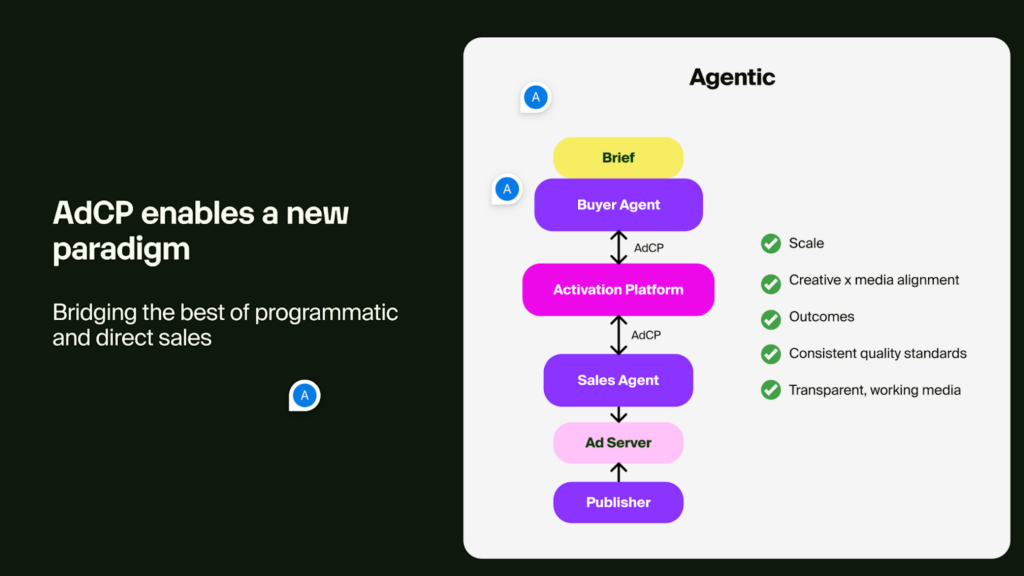

One Selling Agent or Multiple?
I need to wrap my head around how having multiple sales agents works. It’s the agentic world’s equivalent of request duplication. LOL. In all seriousness, I can see this happening purely for different seller agents for different buying channels. One for direct campaigns, one for PGs, one for PMPs within one SSP, one for PMPs within another, etc.
Why not work with everyone? The more sales, the better?
- I would think that having one agent who understands the whole business is better than having many agents with partial information, but I might be behind on how these transactions work, so that could be wrong. I feel like if we move into a world where every publisher has a ton of sales agents, that sounds like duplicating the world we live in now, versus a better advertising model.
- i’m not sure, if my dmp has an agent that really understands my audience and some other company really understands my formats or something else, i’m okay with them each selling and booking deals, much like i am okay with multiple human sales persons specializing in sales of different products or customer sets
- multiple sales people work for a sales manager to make sure that one sales people doesn’t undercut the other sales people.
- sounds like we’ll need a sales manager repo as well
- multiple sales people work for a sales manager to make sure that one sales people doesn’t undercut the other sales people.
- i’m not sure, if my dmp has an agent that really understands my audience and some other company really understands my formats or something else, i’m okay with them each selling and booking deals, much like i am okay with multiple human sales persons specializing in sales of different products or customer sets
The ecosystem is also extremely siloed, especially with exclusive relationships, curation platforms, and as he pointed out, discrete business entities that provide value in their own right, having multiple is beneficial. Pubs and SSPs will work with many.
- Hear me out: so instead of having every SSP I work with create an agent on my behalf, my managed service creates an agent, my OMS, Salesforce, and my DMP all responding to each/every buyer request, why wouldn’t it be better to have AI pull all those systems together so that I have one agent that does the work? My SSP won’t have access to my direct sales rate card, nor will it have my 1st-party data. Additionally, not all of these agents will have access to all that information, nor will they share certain details with me. I’m hoping agentic advertising can help me, as a publisher, have more control. If I have a lot of agents, I feel like we’ve replicated programmatic. Why would we do that? Please, educate me.

Opportunity for smaller markets + who is offering seller agents?
Is anyone offering sales agents yet? It seems like it’s more about building the buy-side functionality and then sending publishers to GitHub to build their own? Or have I missed something in the whole AdCP hype? I actually think that agentic could gain significant traction here in our market, as one of the biggest issues in programmatic advertising is the lack of competence on the buy-side (their opinion, not mine), and the buy-side is very interested in applying AI, according to the IAB. So this could potentially solve a problem here. Our market is one of the only markets where programmatic is declining. And direct is a very laborious activity, so automating most of the direct with agentic seems like a good fit here. Anyways. It looks like we need to set up our own server for a sales agent? No providers on the market yet.

Other Thoughts:
I would be curious to hear from some thought leaders about where they believe publishers with a direct-sales focus should be taking their tech stack in the age of AI agents.
The way I see it is you look to tackle the workflow and develop the process using as many agents as are handling different pieces of the workflow. When you have multiple workflows within the business using different agents/LLMs and throw in RPA you can begin connecting them to create even more efficiencies. I like the idea of developing Agents to support specific roles within an org. Each pub has specific areas that need support and its varied.
- agreed. The more I learn about agents, the more I realize that you build them roles rather than tasks. So a QA agent oversees QA processes. I think the thing I’m looking at is the sales agent role.
- Sales agents can be successful in an agentic marketing environment or a world where agents on both the buy and sell sides operate to push budgets and the pub side builds automated plans. Certain areas will be end-to-end, but many would require that sales relationship to start the process or point the agents so they connect

Hey All – I’ve been trying to read up on AdCP, and I’m noticing a trend that while this is an “open source protocol” and a non-profit entity, I’m seeing a clear direction within the actual documentation into focusing attention on very specific businesses. I think this deviates from providing a new protocol for the industry to funneling revenue to a few select “winners”. Has anyone picked up on that? I don’t really see the altruism that has been communicated externally.
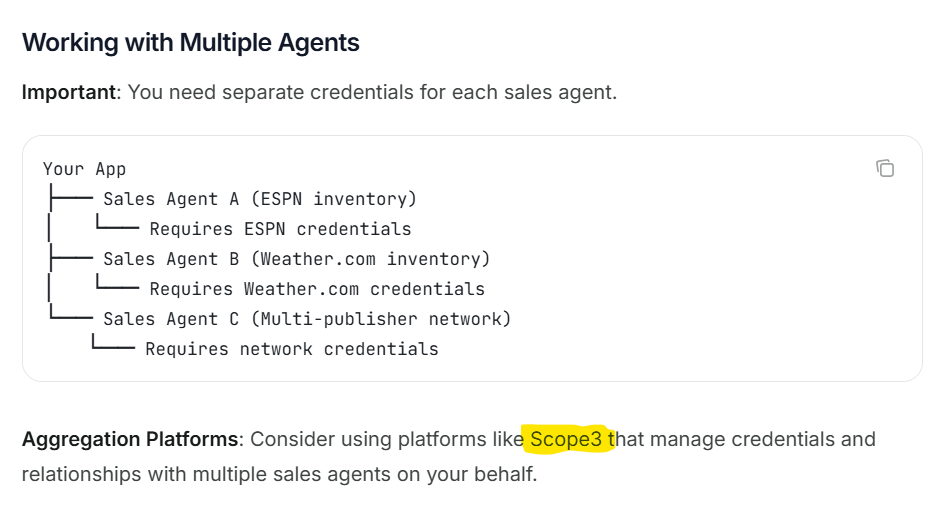
A response: Not defending this. IMO, it seems similar in style to the way Appnexus is still heavily called out in examples on Prebid.org. Appnexus has received various benefits from Prebid since its inception, but this has not hindered Prebid’s ability to be a game-changer in empowering a fair ecosystem.