
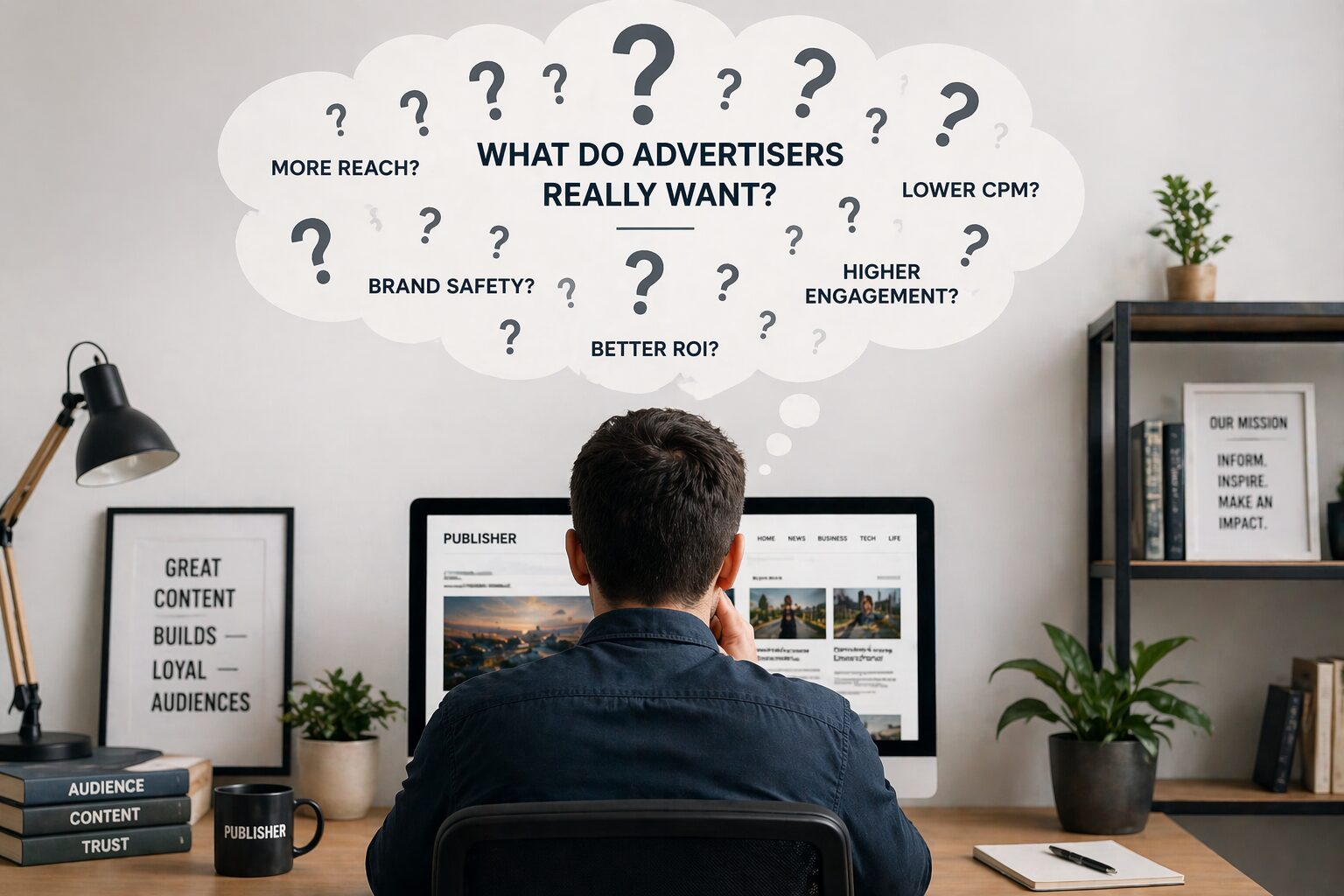
What 18 years as an advertiser taught me that publishers can use today
BY SHAI ALMAGOR, SENIOR DIRECTOR CLIENTS & MARKETING AT KUEEZ

For nearly 18 years, I was the advertiser publishers were trying to reach. I worked with some of the world’s most recognized global brands – ExxonMobil, GE, Accenture, Credit Suisse, InterContinental Hotels, Playtika, and many more – across agencies including McCann, DDB, and WPP.
A significant part of that work was media: planning and buying across every major channel and region, from brand awareness through customer acquisition. I’ve seen what works, what gets cut, and what earns a second look from even the most skeptical CMO.
For the past couple of years, I’ve been on the other side, leading Kueez’s SSP client relationship team, working with both publishers and demand partners to help grow publisher revenue. The move wasn’t accidental. After nearly two decades in agencies, I found myself increasingly fascinated by the technology reshaping the industry: the pipes, the signals, the infrastructure behind every impression. I also grew to appreciate what publishers do: connecting content to the right audiences and serving as one of the few remaining sources of trusted, credible information.
That combination of a curiosity about adtech and a genuine respect for the role publishers play is what pulled me across the fence. That shift gave me a rare vantage point:
I know what advertisers are thinking when they open a media kit or decide which partners make the plan.
What follows is my honest attempt to answer three questions publishers rarely get a straight answer to:
- Why do advertisers choose the open web?
- What actually moves budget decisions?
- And why do some publishers keep winning while others stay invisible?
Why advertisers come to the open web
Over the course of my career, I built hundreds of media plans spanning walled gardens, search, video and CTV, social, programmatic, and direct publisher buys.
When it came to the open web, I was almost always pursuing one of three objectives, and I hope that sharing these will help you better understand advertisers and how to attract them:
Reach beyond the platforms. The major walled gardens are crowded and expensive. When I needed to expand coverage of the same audience without paying a premium for the privilege, the open web was the answer. A well-placed publisher buy could deliver the same target consumer at a more efficient CPM while reinforcing the sense that a brand was truly “everywhere.”
Brand adjacency and the halo effect. Where an ad appears says something about the brand running it. Placing a campaign alongside trusted editorial content is not just buying impressions – it’s borrowing credibility. For global brands that care deeply about perceived authority, appearing next to high-quality journalism or expert analysis carries real weight. Publishers with strong reputations actively reduce risk for advertisers.
High-intent niche audiences. Some of my most effective buys came from small, specialized publishers that most agencies would have overlooked. A niche B2B technology site or an industry-specific newsletter captures an audience at the exact moment they are seeking information and forming opinions. That intent is genuinely hard to replicate in a broad-reach environment, and I was willing to pay higher CPMs to access it.
What publishers can do to win more budget
There’s no doubt that publishers are facing real challenges when it comes to generating revenue (our CRO wrote about this in depth in his article on revenue diversification). But if organic traffic is down and the pressure to monetize what’s left is up, how you position yourself to advertisers matters more than ever. Having sat on both sides of the table, here is what I genuinely believe moves the needle.
Having sat on both sides of the table, here is what I genuinely believe moves the needle, ordered from the lowest-hanging fruit to the longer-term investments that compound over time.
KNOW YOUR AUDIENCE DEEPLY
Start by building a real, deep understanding of your audiences and helping package them into advertising-relevant segments – for example, travelers, soon-to-be parents, students, and other high-intent groups. The media plans I trusted most were built on audience insight, not just traffic numbers. Publishers who can clearly define who their readers are, what they care about, and what they do next and translate that into simple, buyable packages – make a planner’s job easier. That ease translates directly into budget.
CAPTURE + ACTIVATE FIRST-PARTY DATA RESPONSIBLY
As third-party data disappears, publishers that can clearly define and activate these audiences using authenticated, consented first-party signals from newsletters, memberships, and registrations will offer advertisers something genuinely valuable: scarce audience intelligence tied to proven content engagement.
DIVERSIFY YOUR REVENUE STREAMS
Publishers who depend entirely on programmatic CPMs are exposed to volatility that makes long-term planning difficult. Adding direct deals, sponsorships, or newsletters can help, and commerce, increasingly, is becoming a meaningful part of that mix for many publishers. It combines audience trust with scalable, recurring income. The challenge is that building it takes time. Partnering with someone who has already built the infrastructure can shorten that path considerably – worth exploring what’s out there, including what Kueez offers, whether as a bridge while you build or a longer-term play.
BE UNMISTAKABLY UNIQUE
The publishers I returned to year after year were the ones that owned something – a beat, a community, a format, a point of view that could not be replicated anywhere else. If an advertiser can get equivalent reach or context somewhere cheaper, they will. Give them a reason they can’t.
BUILD A READ PUBLISHING BRAND
Trust is the premium product. Advertisers are not just buying eyeballs — they are making a judgment about your credibility. Editorial standards, a clean user experience, transparency, and a clear brand safety posture all send signals that experienced media buyers notice.
The opportunity is real
Nearly two decades on the buy side taught me one thing above all else: publishers have more to offer advertisers than most of them realize. The value is there – in the audiences, the context, the trust, the intent. The gap is usually in how it gets packaged, positioned, and communicated.
The open web is getting harder to navigate, but it is not running out of opportunity. If anything, the shift toward quality and trust is creating more room for publishers who know how to tell their story.
That’s what I find myself most motivated by now – helping publishers see themselves the way the best advertisers see them, and closing the distance between the two. The knowledge flows both ways, and when it does, everyone wins.
Sound interesting? Want to learn more? Let’s connect.
👉 Want to stay in the loop with what’s happening in the Beeler.Tech community? Subscribe to our newsletter. If you’re interested in attending or sponsoring a future event, you can explore our upcoming events here.
This is content created in paid partnership with Kueez. We only feature partners who we believe bring real value to the publisher community.