

Reclaiming distribution: How premium publishers rebuild growth in the post-organic web
BY ZIV MISHAN, CHIEF REVENUE OFFICER AT KUEEZ

For the last few years, digital publishers have been playing a defensive game. The foundation that powered publisher growth for more than a decade is rapidly changing. Search engines are moving toward AI-driven, answer-first experiences that increasingly satisfy user intent without requiring a click.
In addition, social platforms continue to optimize for engagement within their own ecosystems rather than sending audiences elsewhere.
The result is a fundamental shift in the economics of the open web. Organic referral traffic has declined sharply, with publishers reporting a 40% drop in 2026 Q2 alone, according to Digiday. The impact extends far beyond audience metrics: fewer visitors mean fewer advertising opportunities, lower commerce revenue, and increasing pressure on editorial investment.
Yet, the obvious solution, actively investing in paid media to acquire readers, remained a silent taboo.
Paid traffic was the thing premium publishers simply could not talk about at the dinner table. Admitting you bought users meant risking the dreaded three-letter label: MFA (Made For Advertising). It was a designation that could instantly destroy your reputation with media buyers.
Let’s be completely clear: Paying to acquire users has never been the problem. Publishers have successfully used paid acquisition for years to drive subscriptions, newsletters, commerce, and affiliate revenue. These are recognized,healthy, sustainable growth strategies. The radioactive rail was buying traffic specifically to monetize it through open-web programmatic advertising. That was the “bad thing” that got publishers branded as MFA.
To avoid risk, premium publishers kept their paid growth engines far away from programmatic auctions. They routed the economics of paid acquisition to “safe” corners like commerce.
I have spent the last two years in exactly that trench. At Kueez, we focused heavily on building Social-to-commerce engines that now generate massive annual order value for our enterprise premium publisher partners. It works beautifully, and as Jounce Media points out in their July 2026 report, affiliate models are incredibly healthy, high-yield uses of paid media.
But staying confined to the commerce corner was quietly an admission of defeat. It meant conceding that one of the biggest potential levers in digital publishing, turning paid social into a monetizable, premium programmatic audience, was just too dangerous to touch.
Last week, that conversation changed.
Introducing: Compliant Audience Acquisition
The catalyst for this shift is Jounce Media’s July 2026 Supply Path Benchmarking report, which brought data and analysis to one of the most debated topics in digital publishing. Jounce confirmed what some of us have known for years: paid audience development is a business necessity in the post-organic web.
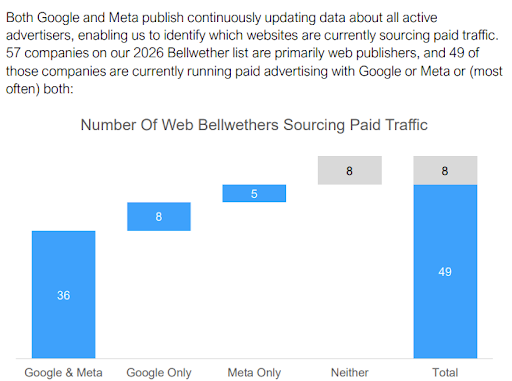
Their data shows that 49 out of the 57 top “Web Bellwethers” (the industry’s most trusted, premium publishers) are actively running paid advertising to acquire users. This is not a marginal tactic; it is the standard playbook of the world’s most successful media brands.
Source: Jounce Media’s July 2026 Supply Path Benchmarking report
The question is no longer if you should buy traffic, but whether you are doing it through the lens of what we at Kueez call “Compliant Audience Acquisition.”
For years, the industry relied on a simple equation: paid traffic = low-quality arbitrage. Jounce’s analysis suggests a more nuanced reality.
Some businesses exist primarily to generate cheap impressions with little organic foundation or long-term value. But when an established publisher with a trusted brand, meaningful content, and a genuine audience relationship uses paid media to expand its reach, the economics can work for everyone: publishers grow, advertisers reach engaged users, and audiences discover valuable content.
The new Jounce playbook
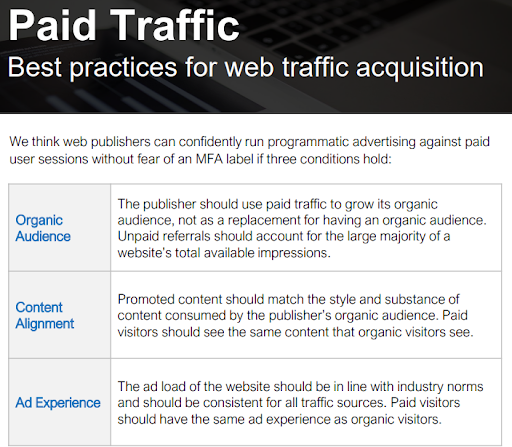
To help premium publishers incorporate audience development into their growth strategy, Jounce introduced a clear three-pillar framework for acquiring high-quality traffic safely and at scale – demonstrating that audience acquisition and programmatic monetization can successfully coexist:
Source: Jounce Media’s July 2026 Supply Path Benchmarking report
This is the core of Compliant Audience acquisition: Maintaining value for advertisers and a great experience for the user, ultimately driving the publisher’s growth.
This is a meaningfully narrower opening than “publishers can now freely buy programmatic traffic.” It’s closer to: if you already have a real audience and a real content identity, paid acquisition that reinforces both is not what the MFA label was built to catch. Sites that use paid traffic as a substitute for having an audience remain squarely in Jounce’s crosshairs, and the data says they should be.
Taken together, these 3 principles redefine paid audience development as an operational discipline rather than a growth hack. Success is no longer measured by the cheapest click or the largest volume of traffic, but by whether acquired audiences generate long-term value while preserving editorial integrity and advertiser performance.
That distinction matters. The publishers that thrive over the next decade will likely be those that treat distribution as a capability they actively build- not a resource they passively receive from Google, Meta, or other platforms.
Beyond buyer classification: the multi-layered compliance matrix
While Jounce Media’s framework provides the essential benchmark buyers use to classify and trust traffic, achieving true compliance in practice requires managing a broader web of ecosystem rules simultaneously. Passing a buyer benchmark is the goal, but reaching it requires a multi-layered operational discipline across every major platform. Key areas include:
- Google Search Safeguards: Protecting root domain health against Google’s Site Reputation Abuse policies by insulating paid subdomains, ensuring organic search equity remains completely untouched.
- Social Platform Alignment: Operating in full compliance with Meta’s or TikTok’s strict destination page guidelines, optimizing for low Cumulative Layout Shift when ad units render, and maintaining clean user experience scores.
- Programmatic & MCM Standards: Maintaining transparent seller authorization through certified Google MCM (Manage Inventory) setups, clean ads.txt mapping, and maintaining IAB standards.
Navigating all of these interconnected nuances simultaneously can feel daunting for an internal team to build and manage manually. This is why specialized compliance infrastructure has become so vital. Technology like what we’ve built at Kueez is engineered to absorb this multi-platform complexity under the hood. By automating the technical guardrails across Google, social networks, and ad exchanges, publishers can focus on what they do best: creating great content, while scaling audience acquisition with complete peace of mind.
From defensive survival to sustainable growth
Now that the guardrails are better defined, standing still is arguably the highest-risk strategy.
The reality is that relying on “algorithmic luck” is a recipe for slow extinction. You cannot scale a sustainable, multi-million dollar media business while praying that search and social platforms send you free traffic.
The economics are straightforward: if distribution is one of your largest business risks, it should also become one of your core capabilities. Building a sustainable media company increasingly requires owning not only content creation, but also audience acquisition.
Jounce’s framework doesn’t hand publishers a blank check to monetize paid traffic however they like.
It hands them a specific, falsifiable test:
- Is your organic base still the majority of your traffic?
- Is the content paid visitors see, offers the same experience and alignment with the content your regulars see?
- Is your ad load similar for everyone?
Publishers that can honestly answer yes to all three have a real basis to operate with confidence. Publishers that can’t are the ones the tightened MFA definition is, correctly, aimed at.
For publishers that meet the criteria, Compliant Audience Acquisition creates a diversified distribution strategy – one that reduces dependence on external platforms while giving publishers greater control over growth, monetization, and long-term resilience.
So at this point, you can either:
- Build scaling capabilities (Tech/expertise) in house, this can give you more autonomous control over growth, but note that scaling audiences profitably, while adhering to the compliance regulations is a real challenge and needs to be handled carefully.
- Partner with expert technology/service providers that specialize in Compliant Audience Acquisition – to leverage the combined strength your publication’s assets, and your partner’s tech/expertise
After spending the last several years helping enterprise publishers build audience development businesses, my conclusion is simple: the next competitive advantage will not come from producing more content alone. It will come from building a disciplined, data-driven distribution engine that compounds over time.
The publishers that thrive in the post-organic web will be those that own both sides of the equation: exceptional content and sustainable distribution. Jounce’s framework provides the blueprint. The execution is now up to the industry.
Meet the author: Ziv Mishan
Drawing on 15 years’ experience at leading tech companies including Publicis, Google, and Kueez, Ziv Mishan focuses on building growth through strategic partnerships and turning high-value assets into sustainable revenue engines. Ziv currently leads revenue strategy at Kueez, a company whose services align with the audience development approach discussed in this piece.
Chat with Ziv at Zivm@kueez.com.
👉 Want to stay in the loop with what’s happening in the Beeler.Tech community? Subscribe to our newsletter. If you’re interested in attending or sponsoring a future event, you can explore our upcoming events here.
This is content created in paid partnership with Kueez. We only feature partners who we believe bring real value to the publisher community.