

Plugging the leaks: How to grow revenue from your existing traffic with Admiral’s Dan Rua
BY ROB BEELER + DAN RUA, CEO OF ADMIRAL
Ask most publishers how they plan to grow revenue next year, and their answer usually centers around the word traffic. Yet as we become all too aware that AI answers are changing how readers find content, and platform traffic is becoming harder to predict than ever, we’re watching that bet get riskier every quarter. Meanwhile, a quieter, more controllable opportunity is sitting inside the audience publishers have already secured.
Rob joins Dan Rua, CEO of Admiral, to dig into what he calls revenue leakage. They discuss where it hides in the visitor journey, why revenue per visitor is a smarter growth measure than raw traffic, and what really makes a pageview monetizable.
Dan also explains how much adblocked inventory publishers can recover, when a one-page session becomes a revenue problem, and the three questions every publisher should ask of their 2027 plan.
Rob: As publishers plan for next year, where are they most likely to overlook revenue already sitting inside their traffic?
Dan: The biggest losses are rarely one dramatic hole. They accumulate across the visitor journey: an adblocked pageview that never monetizes, a session that ends after one page, a visitor who never consents or becomes known, or a reader who leaves with no reason to return.
Publishers have historically organized teams and budgets around acquiring traffic and optimizing individual revenue products. Revenue leakage happens between the two – it’s the difference between what a publisher earns from its current audience and what that audience could generate if more of each visit became monetizable.
Rob: Publishers have spent years measuring growth in traffic. What changes when you focus on revenue efficiency per visitor instead?
Dan: Traffic is still important, but it’s an input rather than the final measure of growth. Once publishers make that switch, the question changes from “how many people arrived?” to “how much monetizable value did we create from each visitor?”
We’ve been using Monetizable Pageviews Per Visitor (MPPV) to make that shift concrete. Whereas traffic tells you how much audience you attracted, MPPV tells you how effectively you monetized that audience.
Rob: What does ’revenue leakage’ actually look like across a publisher’s visitor journey? Where are the most common places money gets left on the table?
Dan: Leakage appears anywhere visitor attention exists, but monetization does not. At the beginning of a visit, inventory may be blocked or lack the consent needed to monetize fully. During the visit, the publisher may fail to route the reader toward another useful article, a high-value page, a direct-sold campaign, or a conversion path. And at the end, the reader may leave without registering, subscribing or forming any connection that brings them back.
The most common mistake is treating each of these as a separate departmental metric, such as adblock rate for ad ops, bounce rate for audience, consent rate for privacy, and conversion rate for subscriptions. They’re all forms of the same problem: value that the publisher earned the chance to create but didn’t capture.
Rob: Beyond serving an ad, what revenue potential can a single pageview hold?
Dan: A monetizable pageview is any pageview that creates a meaningful revenue opportunity rather than simply one where an ad tag fired. One page can deliver programmatic impressions, fulfill a direct-sold campaign, introduce premium content, collect consent or first-party data, advance a registration or subscription journey, and create signals that improve the next interaction.
A second pageview may carry a higher RPM than the landing page, expose a scarce campaign, or create the moment when a reader becomes known. Publishers should optimize for the next-best monetizable action for that visitor and that session, rather than simply for more clicks.
Rob: Adblock is a clear example of leakage because the audience is already there. How much of it can publishers actually recover?
Dan: Publishers often underestimate adblock recovery because they see it as one technique. There’s no single “adblock user,” and no method reaches or monetizes every blocked visitor equally well.
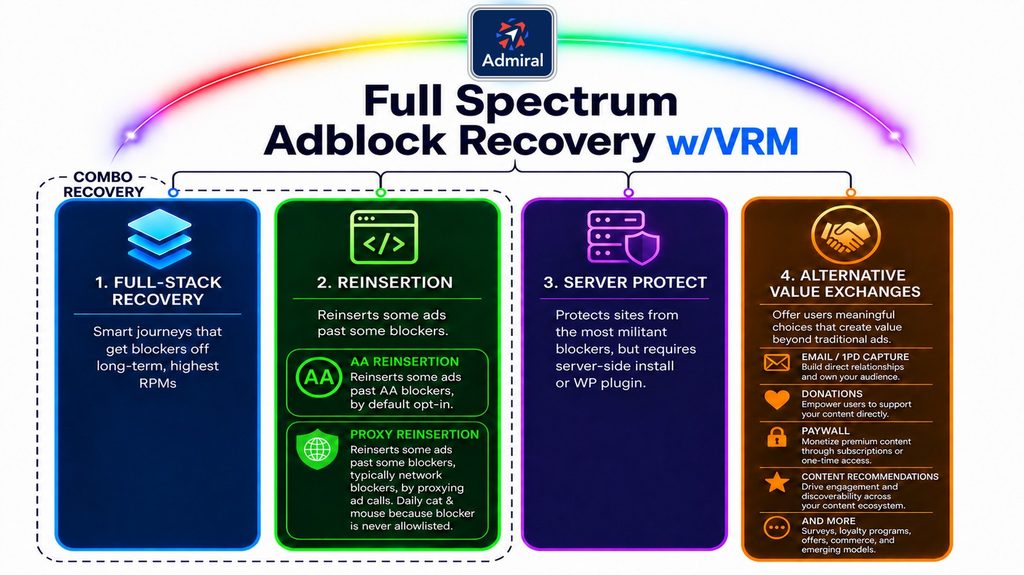
Admiral’s Full-Spectrum Adblock Recovery brings together Full-Stack Recovery, Acceptable Ads reinsertion, proxy reinsertion for dark traffic network blockers, Server Protect for the most militant blockers, and alternative value exchanges when advertising isn’t the right fit.
Each approach restores different inventory, formats and RPMs, so we can pick the path that creates the most value for each visitor. In one head-to-head comparison, Full-Stack Recovery generated 9x the recovered RPM of reinsertion-based recovery.
Rob: A one-page session is usually treated as an engagement problem. When should publishers treat it as a revenue problem too?
Dan: When the publisher has invested in acquiring, creating or serving that visit and the reader leaves before the next valuable action. The cost goes well beyond one ad impression, including direct-sold exposure, subscription opportunities, first-party data and the chance to build a lasting relationship.
That’s why exit recovery and session extension grow revenue as well as engagement. In Admiral Extend deployments, publishers have seen conversion rates of 3-5%, with converting visitors averaging around 2.2 additional pageviews each and delivering revenue lift of 5% or more.
Rob: AI is starting to show up inside the visitor experience. Beyond UX, where’s the biggest opportunity to create more valuable revenue moments?
Dan: Publishers can go well beyond a basic chatbot by building their own conversational layer that deepens engagement, creates new monetization opportunities and reveals what audiences really care about.
That’s what Admiral Visitor Copilot is designed to do. Visitors can ask questions, discover relevant stories and explore a publisher’s expertise conversationally, creating additional pageviews, premium experiences and sponsorship opportunities on the publisher’s own property.
We’ve also rolled out Visitor Copilot Insights, which goes beyond clicks to show publishers what visitors asked and what they want to know next. In fact, when we first enabled Copilot insights on Beeler.Tech, I recall you grokked it immediately, calling these conversational insights “a game changer”.
Rob. That’s right. So when publishers start addressing these leakage points systematically, what changes are you seeing with customers?
Dan: The first change is alignment around a shared visitor-value metric, such as MPPV, ARPV, revenue per session, or LTV, which needs to be defined and consistently reviewed across the organization. Each line of business can report its contribution, and leadership can roll those up into a clearer view of whether the business is creating more value from the audience it already has.
Adblock recovery, consent, session depth, registration, subscriptions, and return frequency stop being disconnected departmental projects and become part of the same question: did this increase the monetizable value of the audience we already earned?
The gains then compound. Recovering blocked inventory creates immediate revenue. Extending sessions creates additional inventory. Turning anonymous visitors into known or subscribed visitors creates future value and return visits. Small improvements at several points in the journey can be far more durable – and often more attainable – than betting the revenue plan on a large increase in traffic.
Rob: If a publisher wanted to pressure-test its 2027 plan for hidden leakage, what three questions should it ask first?
Dan: First, what percentage of our pageviews and sessions never become fully monetizable, and why? Break it down by adblocking, consent, early exits, unfilled opportunities and unknown visitors.
Second, where does the visitor journey end before the next valuable action? Look beyond bounce rate to the moments a reader could have reached another article, higher-value inventory, a registration or a subscription.
Third, is every team optimizing for more traffic or more value per visitor? That’s where a shared visitor-value KPI like MPPV comes in.
Ready to find the revenue hiding in your traffic?
Traffic will always matter, but it’s rarely the most controllable lever publishers have. As Dan shows, plugging leaks across the visitor journey, tracking MPPV, recovering adblocked inventory, rescuing one-page sessions and using AI on-site can all unlock revenue from the audience publishers have already won.
We expect the publishers who build their 2027 plans around that audience to be far less exposed when traffic dips. To go beyond Dan’s three questions, Admiral’s Visitor Relationship Scorecard assesses 20 areas across visitor data and engagement, journey optimization, monetization, and team and technology to pinpoint your biggest gaps and priorities.
Get your site’s Score today.

👉Want to stay in the loop with what’s happening in the Beeler.Tech community? Subscribe to our newsletter. If you’re interested in attending or sponsoring a future event, you can explore our upcoming events here.